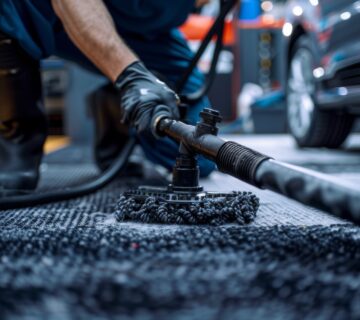
When it comes to cleaning up after our pets, dealing with a urine stain on the carpet is a common—and frustrating—challenge. If you’ve ever scrubbed a spot only to have that tell-tale smell return days later, you know that surface cleaning just doesn’t cut it. The secret to truly effective pet urine carpet cleaning is using a product that goes deeper, like an enzymatic cleaner. These specialised formulas are designed to break down the invisible uric acid crystals that cause those persistent odours, tackling the problem at its source rather than just masking it.
Why Pet Stains Are More Than Just a Surface Problem
When your furry friend has an accident on the carpet, the dark patch you see is really just the tip of the iceberg. The real trouble with pet urine is what’s happening below the surface. The warm urine doesn't just sit on the carpet fibres; it quickly soaks through, penetrating the absorbent backing and, in many cases, reaching the wooden or concrete subfloor underneath.
This is where things get a bit scientific. Pet urine contains several compounds, but the most difficult to deal with is uric acid. Unlike other components that your everyday household cleaners can handle, uric acid forms non-soluble crystals. These tiny crystals are the real culprits behind that stubborn smell that seems to linger no matter how much you clean.
That returning odour isn't just in your head. When the air is humid or warm, moisture reactivates these uric acid crystals, releasing that distinct ammonia smell all over again. It’s why a stain you thought was long gone can suddenly make a reappearance.
The Hidden Damage Underneath
Simply cleaning the surface stain gives a false sense of accomplishment. The discolouration might be gone, but the uric acid crystals are still embedded deep within your carpet’s foundation, leading to some serious issues down the line:
- Persistent Odours: As we've mentioned, that smell will keep coming back. Standard soaps and cleaners just can't break down these stubborn crystals.
- Carpet Fibre Damage: Urine is acidic, and over time, it can weaken and permanently discolour your carpet fibres.
- Subfloor Saturation: If accidents keep happening in the same spot, the urine can soak right through to the subfloor. This can cause much bigger problems, like wood rot or concrete damage, which often require costly and extensive repairs.
With so many of us being pet lovers, these are very common household problems. In the UK, around 34% of households own a dog and 28% own a cat, which means millions of homes are facing the very same pet urine cleaning challenges. You can explore the full scope of this in the latest UK pet ownership statistics.
Understanding the hidden damage makes it clear why a quick scrub on the surface is destined to fail. To truly get rid of the stain and the smell, you need a method that can penetrate just as deeply as the urine itself to neutralise the uric acid at its source. This isn't just about making your home look and smell nice; it's about protecting your investment and maintaining healthy indoor air quality.
Your First Response to a Fresh Carpet Accident
That moment you spot a fresh pet accident… the clock is officially ticking. Honestly, what you do in the next few minutes makes all the difference between a quick clean-up and a permanent stain with that lingering odour we all dread. Your immediate mission is simple: extraction.
Your gut instinct might be to grab a brush and give it a good old scrub. Please don't. It's genuinely the single biggest mistake you can make. Scrubbing doesn't lift the urine out; it just grinds the liquid deeper into the carpet pile. Worse, it forces the urine past the fibres and into the absorbent backing and underlay, which is where the real odour problems take root.
The Power of Blotting
Instead of scrubbing, your best friend here is blotting. It’s all about absorption, not abrasion. Grab a thick wad of paper towels or a clean, very absorbent cloth (an old white towel is perfect) and press down firmly on the wet spot.
You’ll be amazed at how much liquid you can draw out this way. Don't be shy—put your full body weight on it. I often tell clients to stand on the towels for 30 seconds to really maximise the pressure. Lift, swap the soaked towels for a fresh, dry stack, and do it again. Keep repeating until the towels are coming up almost dry. Taking this immediate action is the most effective thing you can do to stop the urine from setting.
This simple process is the cornerstone of effective pet urine cleaning.
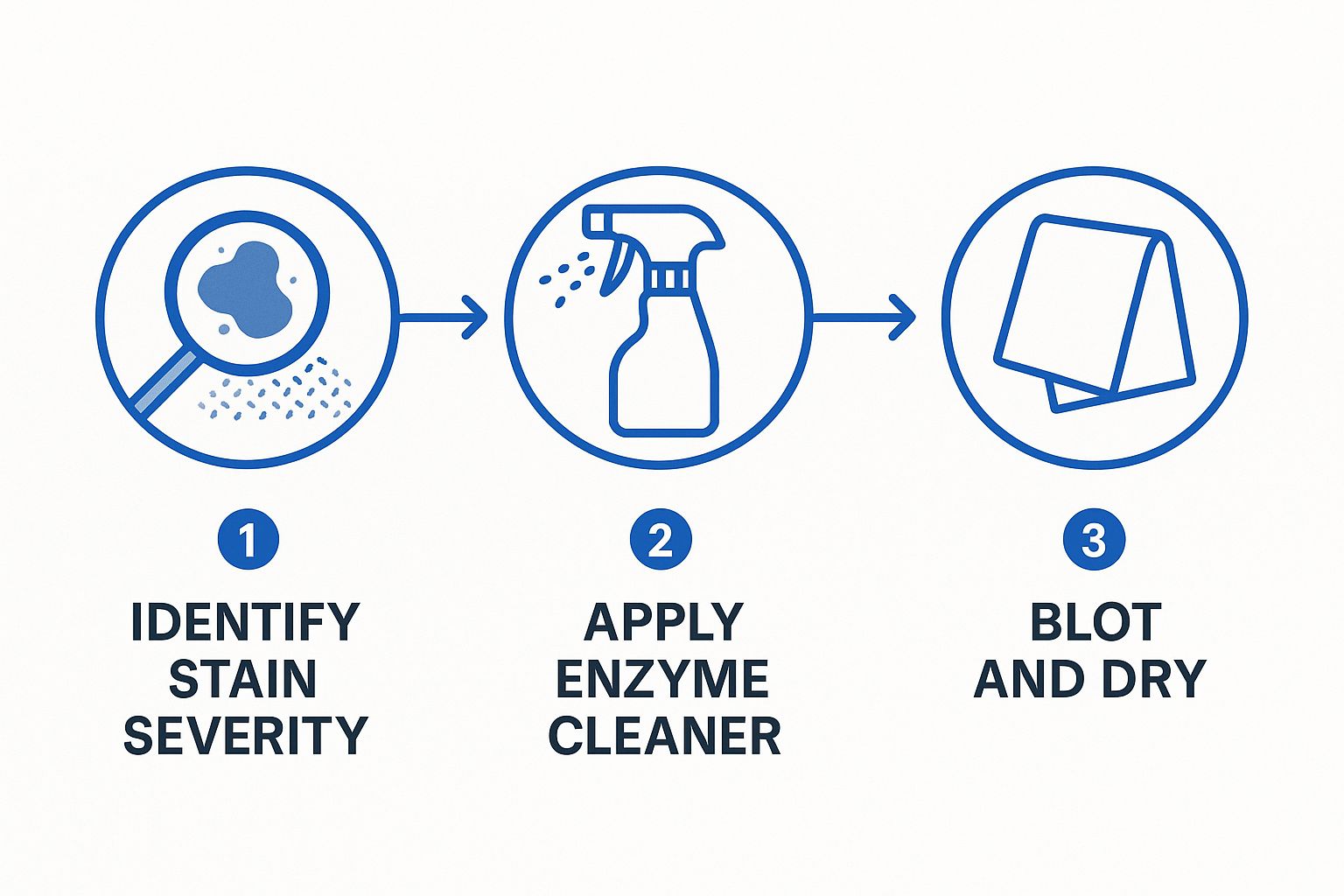
As you can see, after that crucial first blotting stage, you need a proper cleaning solution to neutralise what’s left behind before letting it dry.
What to Use for Blotting
When it comes to choosing your blotting material, think maximum absorbency. Here are your best bets:
- Paper Towels: A thick, quilted roll is ideal. They’re effective and you can just throw them away afterwards.
- White Cotton Towels: Old, clean towels work wonders. Just make sure they're white to avoid any risk of dye transferring onto your carpet.
- A Shammy Cloth: These are literally designed for high absorbency and can be rinsed out and reused.
Pro Tip: Never, ever use a coloured or patterned cloth for blotting. The moisture combined with the acidity of urine can make the dye from the cloth bleed, leaving you with a second, much more stubborn stain to deal with.
Once you’ve blotted up as much as you possibly can, you've already won half the battle. This first response minimises the damage and preps the area for a deeper, more targeted clean. While this guide covers what to do in the heat of the moment, for older or more set-in spots, you might want to look at our detailed guide on how to remove stubborn carpet stains.
DIY Solutions That Genuinely Neutralise Odours
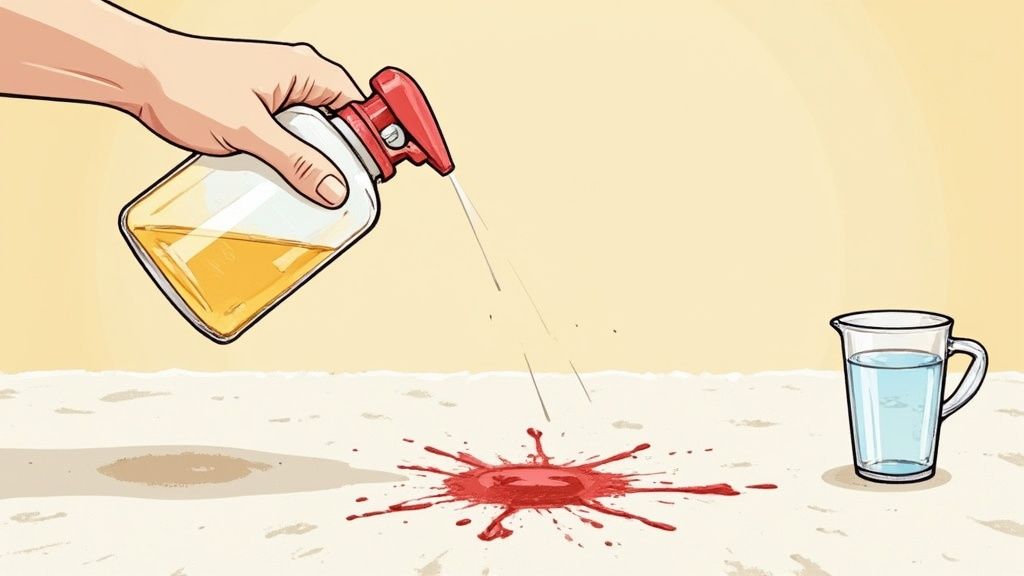
After blotting up that initial accident, it’s all too tempting to grab the first cleaner you see under the sink. But hold on. Getting pet urine out of carpets is a matter of chemistry, not just elbow grease. The right homemade concoction can work wonders on the alkaline salts in urine, but the wrong one can set the stain and smell permanently.
Many of us have the key ingredients for a good first response sitting right in our kitchen cupboards. For fresh, minor accidents, these simple solutions can be surprisingly effective, but only if you understand why they work. It all comes down to breaking down the different parts of the urine to eliminate odours at the source.
The most popular and, in my experience, most reliable DIY method involves two household champions: white vinegar and bicarbonate of soda. Their opposing pH levels work together to deliver a powerful one-two punch against both the stain and the lingering smell.
The Vinegar and Bicarbonate Method
This technique is a classic for a very good reason. First up, the acetic acid in the white vinegar goes to battle with the ammonia in the urine. Since ammonia is alkaline, the acid in the vinegar helps to neutralise it, tackling one of the main culprits behind that awful smell right away.
Creating Your Vinegar Solution
- In a clean spray bottle, mix a solution of 50% white vinegar and 50% cool water.
- Lightly spray the affected area. You want to saturate it just enough to reach the same depth the urine did, but don't flood it.
- Using gloves, gently work the solution into the carpet fibres with your fingers or a soft cloth. Don't scrub vigorously, as this can damage the pile.
- Blot the area thoroughly with clean, dry cloths or paper towels until it feels almost dry.
Now it's time for the bicarbonate of soda to shine. It’s a fantastic natural deodoriser that will absorb any remaining moisture and odours that the vinegar couldn't quite shift.
After blotting the vinegar mixture, sprinkle a generous layer of bicarbonate of soda over the still-slightly-damp patch. You might hear a gentle fizzing sound as it reacts with any remaining vinegar – that's a good sign! Leave it to do its job for several hours, or even overnight if you can, until it’s completely dry.
Once the bicarbonate of soda is bone dry and has formed a crust, simply vacuum it all up. This two-step process can be remarkably successful, especially on fresh stains. If you're dealing with the notoriously stubborn smell of cat urine, our dedicated guide on how to get rid of cat pee smell offers more targeted advice.
Cleaners You Must Avoid
Knowing what not to use is just as crucial as knowing what works. The wrong product can create a chemical reaction that permanently locks the stain and odour into your carpet fibres.
Ammonia-Based Cleaners
Whatever you do, never use a cleaner that contains ammonia, like certain glass cleaners. Urine already contains ammonia, so adding more will only make the smell stronger. Worse still, it can act as a powerful signal to your pet, encouraging them to use the same spot as a toilet again.
Household Soaps and Scented Sprays
Standard washing-up liquids or laundry detergents often leave behind a sticky residue that will attract dirt, leading to a dark patch over time. And while scented sprays might seem like a quick fix, they only mask the odour. They do nothing to break down the uric acid crystals, meaning that unpleasant smell is guaranteed to return once the fragrance wears off.
How to Tackle Stubborn Old Stains and Smells
Fresh pet accidents are one thing, but those old, set-in urine stains are a different beast entirely. We’ve all been there – you think you’ve cleaned a spot perfectly, only for that unmistakable smell to return with a vengeance on a humid day. This happens because most household cleaners can’t break down the stubborn uric acid crystals that burrow deep into your carpet fibres, the backing, and sometimes even the subfloor below.
To win this battle, you need to bring in the heavy artillery. Forget basic DIY solutions; it’s time for something with a bit more scientific firepower. This is where enzymatic cleaners become absolutely essential for any serious pet urine carpet cleaning mission.
The Science of Enzymatic Cleaners
Enzymatic cleaners aren't just another fancy soap. They are powerful bio-cleaners loaded with beneficial bacteria that produce specific enzymes. These enzymes are nature's own cleaning crew, designed to break down and literally "digest" the organic matter in pet urine—especially the proteins and the odour-causing uric acid crystals.
Think of it this way: the enzymes are like millions of tiny Pac-Men, chomping away at the stain and smell molecules until there’s nothing left. While regular cleaners might just mask the smell with perfume or push the stain around, an enzymatic product dismantles the problem right at the source.
The single most important part of using an enzymatic cleaner is giving it dwell time. This is not a quick spray-and-wipe job. You have to let the product sit, often for several hours or as directed on the bottle, to give the enzymes enough time to get to work. If you rush this step, the product simply won't be effective.
In the UK, where so many of us are proud pet owners, we see firsthand how pet urine can cause serious, lasting damage to carpets. When left untreated, those odour molecules seep far beyond the surface, contaminating the carpet backing and the underlay beneath. This is often when professional help becomes necessary. You can find more insights on urine's deep-seated impact on carpets from industry professionals.
Hunting for Hidden Stains with a UV Torch
Sometimes the worst smells come from stains you can't even see. Pets are notorious for having little accidents in out-of-the-way corners or on patterned carpets where the evidence is well-hidden. If you’ve cleaned everywhere you can see but a phantom odour lingers, it's time to play detective.
A simple UV torch (also known as a blacklight) is your secret weapon here. Turn down the lights, and shine the torch across your carpet. The salts in dried urine will glow a distinct yellowish-green under the UV light, revealing every single hidden spot that needs your attention.
Once you've marked all the problem areas, you can treat each one thoroughly with your enzymatic cleaner. It's a game-changing technique that will help you finally get rid of those mystery smells for good. For more tips on this, don't miss our detailed guide on how to permanently remove dog urine smell from your carpet.
Knowing When to Call a Carpet Cleaning Professional
While DIY methods and enzymatic cleaners are fantastic for tackling fresh accidents, there comes a point where even the most determined pet owner is outmatched. Recognising this limit is crucial for effective pet urine carpet cleaning and, more importantly, for preventing permanent damage to your flooring. If you feel like you're stuck in a never-ending cycle of cleaning the same spots, it’s probably time to call in the experts.
One of the most telling signs is a stain that just keeps coming back. You clean it, it disappears, and then a day or two later, a faint shadow returns. This frustrating problem, known as "wicking," happens when urine has soaked deep into the carpet backing or even the underlay. As the surface dries, moisture from below wicks its way up the carpet fibres, bringing deeply embedded urine salts with it. No amount of surface scrubbing will fix this; you need powerful extraction to pull those contaminants out from the very bottom.
When the Problem Is Beyond DIY
Another clear sign is the sheer scale of the issue. If you're dealing with multiple accidents across a room, or if a large area was saturated while you were out, a professional approach is essential. Widespread contamination almost guarantees the urine has seeped deep into the underlay and potentially the subfloor itself.
The most stubborn challenge is a persistent odour that you just can't shake, no matter how many times you clean. This lingering smell is a sure sign that uric acid crystals are still active deep within the carpet's foundation, far beyond the reach of any shop-bought products.
Professionals bring technology to the fight that simply isn't available for home use. Their primary weapon is hot water extraction, a method far more powerful than any household steam cleaner. They use industrial-strength machines to inject a specially formulated cleaning solution deep into the carpet under high pressure, which is then immediately extracted by a high-powered vacuum. This process flushes out the entire carpet structure, removing deep-set urine, leftover cleaning agents, and ground-in dirt all at once. For more on professional methods, our guide to carpet cleaning for pet urine provides a much deeper dive.
Choosing the Right Professional
When you do decide to hire help, it’s vital to choose a reputable company. Don’t just go for the cheapest quote you can find; look for certified technicians who specialise in pet odour and stain removal. A great way to ensure quality in the UK is to look for members of the NCCA (National Carpet Cleaners Association).
Hiring a company with NCCA membership means they are:
- Fully insured.
- Professionally trained to the latest industry standards.
- Bound by a strict code of practice.
An NCCA-certified expert has the right knowledge and equipment to properly diagnose the problem, using tools like moisture detectors and UV lights to find every hidden spot. They can then offer targeted treatments, including powerful sanitisers and deodorisers, to truly eliminate the issue at its source, giving you back a clean, fresh, and healthy home.
Your Top Pet Urine Cleaning Questions Answered
When you're faced with a pet accident on your carpet, it's natural to have a lot of questions. Over the years, we've heard just about all of them! Let's tackle some of the most common queries we get from homeowners, giving you the clear, straightforward advice you need.
Can I Use a Steam Cleaner on Pet Urine?
This is a question we hear all the time, and our answer is always a firm no. It might seem like a good idea, but using a standard household steam cleaner on a urine stain is one of the worst things you can do.
The intense heat from the steam literally cooks the proteins in the urine, bonding them permanently to your carpet fibres. This process sets the stain and the odour, making them almost impossible for even a professional to remove later. It's a critical mistake to avoid.
What professionals use is a technique called hot water extraction. It’s a completely different process. We first apply a specialised cleaning solution that breaks down the urine molecules. Then, our high-powered equipment flushes the carpet with hot water and immediately extracts it, pulling all the dissolved contaminants out without ever "setting" the stain.
Will Vinegar and Bicarbonate of Soda Really Work?
For a brand-new, small accident, a homemade mix of white vinegar and bicarbonate of soda can actually be quite helpful. The vinegar’s acidity works to neutralise the ammonia in fresh urine, which is what causes that initial sharp smell. The bicarb then helps to soak up the leftover moisture and odour.
However, this popular DIY fix has its limits. It's often not powerful enough for old, large, or repeated stains because it cannot chemically break down the stubborn uric acid crystals. These crystals are the reason odours return, especially on damp or humid days.
How Do I Stop My Pet from Re-Soiling the Same Spot?
Stopping a pet from returning to the scene of the crime is a two-part mission: you have to tackle the environment and the pet's behaviour.
First and foremost, you must get rid of the odour completely. Even if you can't smell it, your pet’s powerful nose can. Any trace of a lingering scent acts like a bright, flashing sign telling them, "This is the toilet!" A high-quality enzymatic cleaner is the only way to break down those scent markers for good.
Second, you need to figure out why it's happening.
- Medical Issues: A health problem, such as a urinary tract infection (UTI), is often the culprit behind house soiling.
- Behavioural Triggers: Things like stress, a new pet, or a change in routine can also cause accidents.
Your first port of call should always be the vet to rule out any underlying health conditions. From there, you can look into behavioural training. For more advice on product selection, have a look at our guide to pet-friendly carpet cleaning.
Are Enzymatic Cleaners Safe for My Family and Pets?
Yes, the vast majority of reputable enzymatic cleaners are designed to be safe for use around children and pets, as long as you let the area dry completely first. The active ingredients are simply biodegradable proteins (enzymes) that are designed to digest organic matter like urine.
That said, you should always read the label and follow the manufacturer's instructions. As a rule of thumb, it's always smart to keep pets and little ones out of the room while the product is wet and ensure there's good ventilation as it dries.
When your best efforts just aren't cutting it against tough stains and persistent smells, it’s time to call in the professionals. At AG Carpet Specialists, we have the professional-grade equipment and know-how to resolve even the most challenging pet urine problems, leaving your carpets truly fresh and clean. Contact us today for a free, no-obligation quotation at https://www.agcarpetspecialist.co.uk.