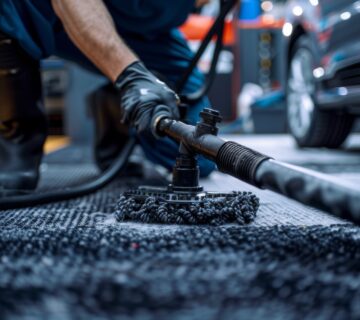
Yes, you can steam clean wood floors, but—and this is a big but—it’s a risky business that’s only suitable for floors with a flawless seal. The heart of the problem is forcing hot, pressurised moisture into timber, which can lead to irreversible damage like warping, swelling, and ruining the finish. This method is never a good idea for solid hardwood, or any floors that are unsealed, oiled, or waxed.
The Great Debate Over Steam Cleaning Wood Floors
The idea of using pure steam to sanitise your floors is certainly appealing. Who wouldn't want that? But when you're talking about wood, you're wading into a very controversial topic in the cleaning world. The conflict is straightforward: wood and water just don't mix well. High-temperature steam can find its way into microscopic gaps in your floor's finish, forcing moisture right into the wood fibres themselves.
That’s where the real trouble starts. Once moisture penetrates the wood, it causes the grain to swell, kicking off a host of problems you really want to avoid:
- Warping: You’ll see the boards twist and begin to lift away from the subfloor.
- Cupping: This is when the edges of the planks rise up higher than their centre.
- Splitting: As the wood expands and then contracts, ugly cracks can appear.
- Finish Damage: The protective sealant can turn cloudy, start to peel, or break down completely, leaving your wood exposed.
Understanding the UK Climate and Flooring Risks
Here in the UK, the risk is even greater. Our temperate climate, with its constant back-and-forth humidity levels through the seasons, already puts a lot of stress on wooden floors. Adding intense, pressurised steam to that equation can fast-track the damage. It’s why so many flooring experts and manufacturers in the UK will tell you point-blank to avoid steam cleaning. In many cases, doing so will instantly void your flooring warranty.
This is exactly why figuring out your floor type is a non-negotiable first step. A perfectly sealed, high-quality engineered wood floor might be able to handle a very careful, occasional steaming. Solid hardwood, on the other hand, is far too vulnerable. And if your floors have an oiled or waxed finish, it's an absolute no-go; the steam will simply strip those protective layers right off. For a deeper look into this subject, our guide on steam cleaning wooden floors provides additional details.
The core takeaway is this: Steam cleaning wood floors isn't a simple 'yes' or 'no' question. It's a calculated risk that depends entirely on your specific floor's material, the integrity of its sealant, and the technique you use.
Setting Realistic Expectations
Before you even think about plugging in that steam mop, it’s vital to have realistic expectations. This isn't a magic wand for your everyday cleaning routine. It's a very aggressive deep-cleaning method that should be reserved for rare occasions—if you decide to do it at all.
For your day-to-day upkeep, a slightly damp microfibre mop paired with a good pH-neutral wood floor cleaner is still the safest and most effective choice. This guide is here to walk you through the process as safely as possible, but understanding the significant potential for costly mistakes is the most important first step you can take.
How to Know if Your Floor Is a Candidate for Steaming
Before you even think about plugging in a steam mop, the first and most critical job is to play detective with your flooring. I can't stress this enough: using a steam cleaner on the wrong type of wood can lead to catastrophic damage. We're talking about warping, peeling, and repairs that cost a fortune. The safety of wood floors steam cleaning comes down to one thing: the floor’s construction and its current condition.
Not all wood floors are created equal. Solid hardwood, engineered wood, and laminate might look similar to the untrained eye, but their ability to handle moisture is worlds apart. Solid hardwood is just a single piece of timber, which makes it extremely vulnerable to cupping and warping when hit with high-pressure steam.
Engineered wood, with its real wood top layer bonded to plywood, has a bit more stability. However, the seams between the boards are still its Achilles' heel. Then there's laminate flooring, which isn't really wood at all—it's a synthetic product with a photographic layer over a fibreboard core. Steam can easily get into its seams, causing the core to swell up like a sponge and the surface to bubble or peel away. For these reasons, steam cleaning is almost universally a bad idea for solid hardwood and laminate.
Checking Your Floor's Protective Seal
The only thing standing between steam and disaster is your floor’s sealant. The only scenario where steaming might be on the table is with certain types of engineered flooring that have a perfectly intact, factory-applied polyurethane finish. You absolutely must test its integrity first.
The easiest way to do this is with a simple water bead test. Just place a single drop of water on a high-traffic area of your floor and watch what happens.
- If the drop beads up and just sits on the surface, your sealant is likely doing its job.
- If the water slowly soaks in or leaves a dark spot behind, your seal is compromised. Stop right there. Steam will penetrate that weak spot even faster.
Take a walk over your entire floor and look closely for any imperfections. Check for gaps between the boards, deep scratches that have gone through the finish, or any areas where the sealant has visibly worn away. These are all open doors for moisture.
Remember, a floor's finish wears down over time, especially in hallways or the centre of rooms. What was once a perfect seal may now be a network of microscopic vulnerabilities that steam will exploit.
Reviewing the Manufacturer's Warranty
When in doubt, the manufacturer has the final say. Before you go any further, dig out your flooring paperwork or search online for the brand’s specific care instructions. You'll find that almost all manufacturers explicitly warn against steam cleaning, and using a steam mop will immediately void your warranty.
This means if the floor warps or the finish peels after you've steamed it, the cost of repair or replacement falls squarely on your shoulders.
Below is a quick checklist to help you make the right call.
Wood Floor Steam Cleaning Suitability Checklist
This table is a quick-reference guide to help you assess whether your wood flooring is a candidate for steam cleaning based on its type and condition.
| Floor Characteristic | Safe to Steam (with caution) | Avoid Steaming (High Risk) |
|---|---|---|
| Floor Type | Some high-quality, fully sealed engineered wood. | Solid hardwood, laminate, bamboo, unsealed wood. |
| Sealant Condition | Brand new or recently refinished with a flawless, waterproof seal. | Worn, scratched, or compromised finish in any area. |
| Gaps Between Boards | No visible gaps; planks are tightly fitted. | Any visible gaps or separation between planks. |
| Manufacturer's Guide | Specifically states that light steam cleaning is permissible. | Warns against steam or moisture; voids warranty. |
Ultimately, if you’re unsure about your floor type or its condition, it is always safer to stick with proven methods. Learning how to clean wood floors with a simple pH-neutral cleaner and a damp microfibre mop will give you fantastic results without the high stakes. Risking your entire floor for a deep clean is a gamble that rarely pays off.
Selecting The Right Steam Mop And Settings
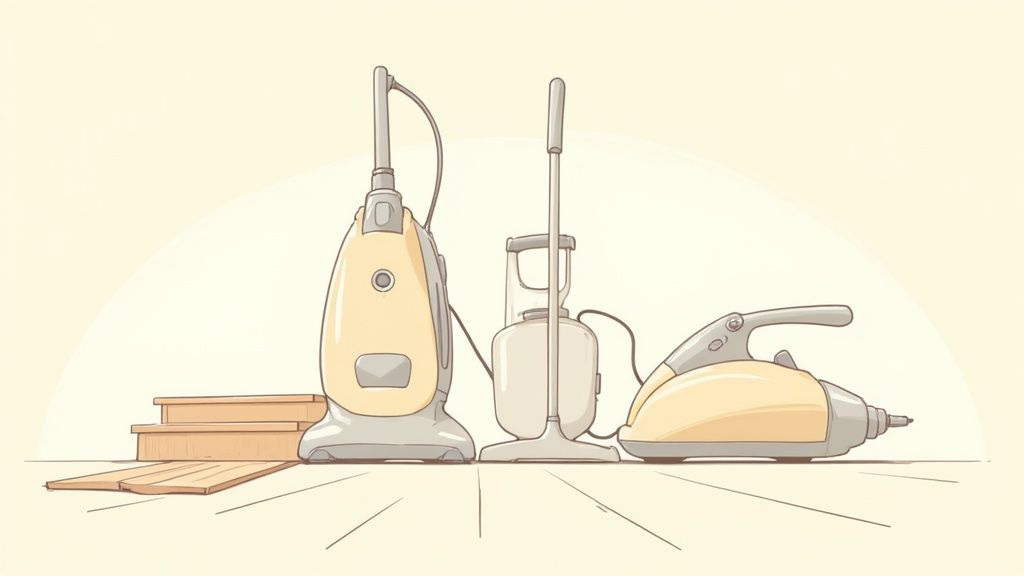
When you decide to steam clean your wood floors, picking the right equipment isn't just a suggestion—it's absolutely critical. Not all steam mops are built the same, and choosing the wrong one can cause real damage. The single most important feature to look for is variable steam control. A machine that only blasts out one high, fixed-heat setting is going to drench your delicate floor in far too much moisture.
You wouldn’t use a pressure washer to clean a watercolour painting, would you? It’s the same logic here. A powerful, wet steam is the enemy of wood. You need a model that lets you dial the output right down to its lowest setting, giving you a 'dry steam'. This is essentially a low-moisture vapour that cleans effectively without saturating the surface.
Key Features For Wood Floor Safety
Beyond adjustable settings, a few other features are non-negotiable if you want to protect your investment. High-quality, absorbent microfibre pads are a must-have. They do two crucial jobs: lifting away the grime and, just as importantly, wicking away any leftover moisture before it has a chance to seep into the seams of your floorboards.
Keep an eye out for a steam cleaner with these specific attributes:
- Multiple Steam Levels: A machine with at least three settings (low, medium, and high) gives you the control to use the absolute minimum amount of steam needed.
- Highly Absorbent Pads: The thicker and more absorbent the microfibre pad, the better. It's wise to have several clean, dry pads ready to swap out as soon as one starts to feel damp.
- Rapid-Drying Technology: Some of the more advanced models are designed to operate in a way that leaves surfaces almost immediately dry to the touch, which is a huge plus.
Remember, using the wrong accessories can be just as damaging as using the wrong machine. For a more detailed look at proper upkeep, our guide on hardwood floor cleaning and polishing offers extra tips to keep your floors in top condition.
The Importance Of Distilled Water
Another detail that’s often missed is the water itself. You should always, without exception, use distilled water in your steam mop. Tap water, particularly in many parts of the UK, is loaded with minerals like calcium and magnesium.
When this ‘hard water’ is heated, it leaves behind a chalky mineral deposit known as limescale. This build-up will eventually clog the machine’s internal parts, causing it to spit and sputter. That leads to uneven steam and potential water spots all over your floor. Over time, these mineral deposits can also create a dull, hazy film on your floor's finish, completely undoing all your hard work.
A common mistake is assuming any water will do. Using tap water can not only damage your steam mop over time but also leave a subtle, cloudy residue on your beautiful wood floors, making them appear perpetually dirty.
By carefully selecting a machine with precise controls and using the correct type of water, you dramatically reduce the risks. In fact, this preparation is the most important part of the entire process, setting you up for the safest possible outcome.
A Safer Method for Steam Cleaning Wood Floors
Right, so you've confirmed your floor is perfectly sealed and you’ve got your hands on a steam mop with those all-important low-moisture controls. Now comes the part that really matters: your technique. How you actually perform the wood floors steam cleaning is every bit as crucial as the prep work.
This isn't a job you can rush. A slow, methodical approach is the only way to get that deep-down clean from steam without inviting the potential for disaster. Every movement is about minimising how much moisture your beautiful wood floor is exposed to.
The process actually starts well before you even think about filling the machine. Your first job is to get that floor completely free of debris. Any grit, dust, or pet hair left behind will get dragged around by the mop pad, creating tiny scratches in your floor's finish. Get the hoover out—using a soft brush head attachment—or go over the whole area with a dry microfibre mop. You need a completely clean canvas to work on.
Mastering The Cleaning Technique
With the floor prepped and ready, it’s all about movement. The number one rule of steam cleaning wood is to never let the mop rest in one spot. Seriously. Even a few seconds of stationary steam can force moisture into the seams between planks or start to soften that protective finish. You're aiming for constant, fluid motion.
Keep the mop moving at a steady, even pace, much like you would when vacuuming. This stops any single area from getting too hot or too damp. It's also vital to stick to a 'one-pass' rule. Clean an area once and move on. You have to fight the temptation to go back and forth over the same spot, as this just adds unnecessary moisture.
This simple graphic breaks down the key safety points.
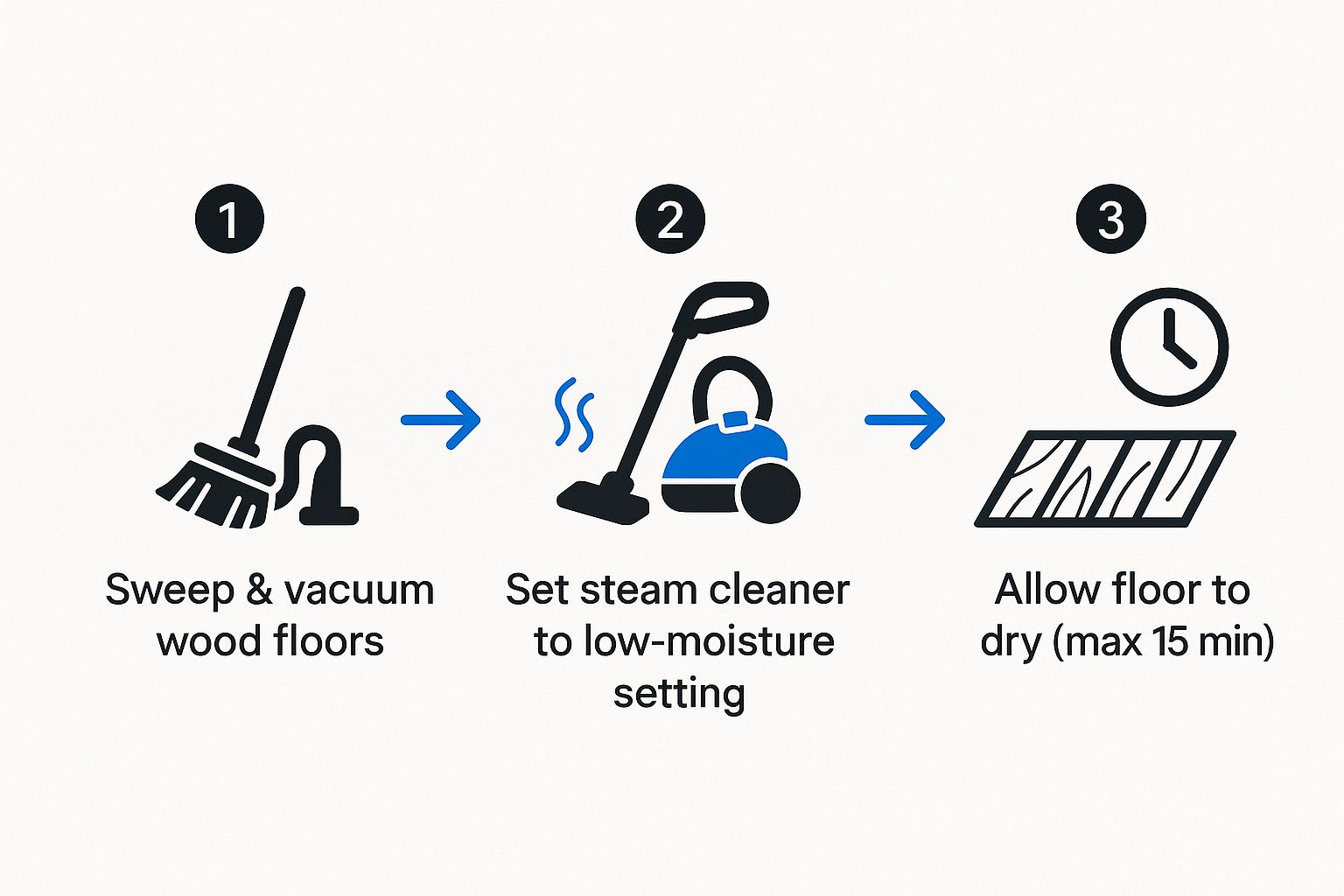
As you can see, preparing the floor beforehand and drying it quickly afterwards are just as important as the cleaning itself. It's a complete cycle of care.
Working Methodically and Staying Dry
To keep things under control, it’s best to break the room down into smaller, more manageable sections. I find working in areas of about one square metre at a time is perfect. Clean one patch completely, then move onto the next, always working your way towards the door so you don’t have to walk over the freshly cleaned floor.
The most overlooked but arguably most important step is immediate drying. Even with a low-moisture setting, some residual dampness is inevitable. Letting this air-dry is a gamble you don't want to take.
As soon as you finish a section, follow up with a clean, dry microfibre cloth to wipe away any trace of moisture. You can pop one on a dry mop head for ease or just do it by hand. The floor should feel dry to the touch within a minute or two. If it’s taking longer than 10-15 minutes to dry, that's a clear sign you're using too much steam.
For more maintenance advice, our guide on hardwood floor cleaning and polishing offers some great tips that work well with this process. By being this meticulous, you're giving your floors the best possible chance of a safe, effective deep clean.
Common Steam Cleaning Mistakes to Avoid
Even when you've got the right type of floor and the best equipment on the market, a few simple mistakes can lead to costly, and sometimes irreversible, damage. Knowing what not to do is your best defence against turning a deep clean into a deep regret. It's often the small errors that compound over time and cause the real problems.
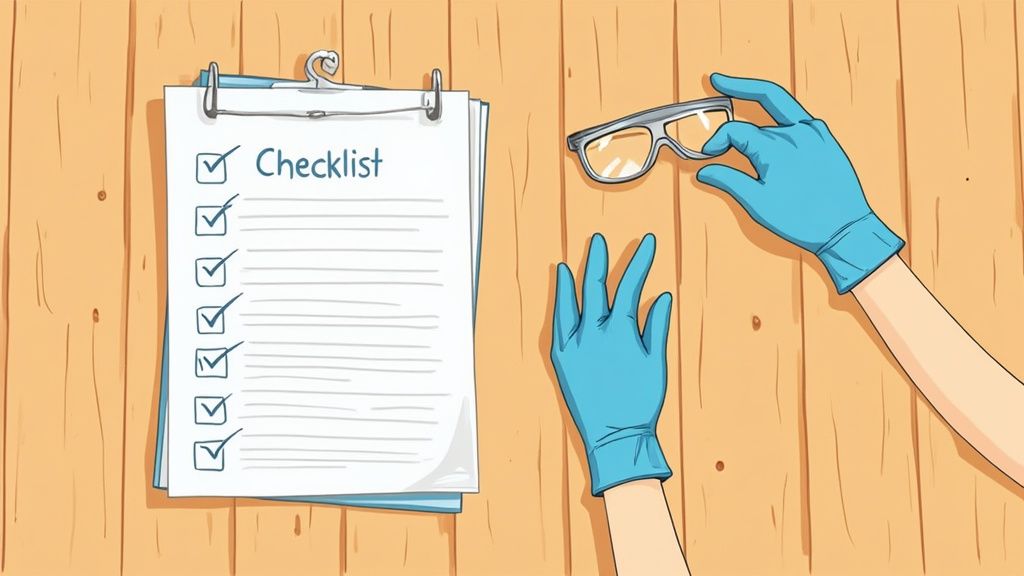
One of the most common blunders I see is simply using too much steam. It's an easy assumption to make—more steam must mean a better clean, right? With wood, it’s actually the opposite. Cranking the machine to its highest setting or moving too slowly over one spot forces an excessive amount of moisture into the seams and grain of the wood. This is a fast track to warping and ruining the finish.
Another critical error is not drying the floor immediately after a pass. People often assume the heat from the steam will take care of evaporation, but any dampness left lingering is a threat. Always have a dry microfibre cloth handy and wipe away every last trace of moisture as you go.
Additives and Unsealed Boards
A mistake that can damage both your floor and your expensive machine is adding detergents or scented oils to the steam mop’s water tank. These machines are engineered for water, and water only. Adding other substances can clog the internal components and, even worse, leave a sticky, dull residue on your beautiful floor that just attracts more dirt.
Never add anything other than distilled water to your steam cleaner. The pure steam is what sanitises the surface; chemical additives will only compromise your floor’s finish and potentially void your machine’s warranty.
Perhaps the single biggest mistake, though, is trying to steam clean a floor that shouldn’t be steamed in the first place. Using a steam cleaner on unsealed, warped, or already damaged boards is a recipe for disaster. The steam will instantly find its way into those weak spots, turning a tiny gap or a minor scratch into major damage like cupping or plank delamination.
The risks here aren't just theoretical. UK trade reports show that a significant number of hardwood floor damage claims are linked directly to incorrect cleaning methods, with steam mopping being a frequent culprit. In fact, some surveys indicate that over 70% of homeowners who steam mop an unsuitable wood floor notice visible damage within just six months.
Steam cleaning is brilliant on surfaces like tile or sealed stone, but its application on wood requires a completely different mindset and level of care. To see how different methods stack up, our article on carpet cleaning vs steam cleaning offers some valuable perspective on where steam really shines. By avoiding these all-too-common errors, you can protect your investment and keep your floors looking fantastic for years to come.
Frequently Asked Questions
Even when you're being careful, it's natural to have questions about the risks involved with steam cleaning wood floors. Getting straight answers is vital before you jump into such a high-stakes cleaning method. Let's walk through some of the most common queries we hear.
How Often Can I Safely Steam Clean My Engineered Wood Floor?
This is a deep-cleaning method, not something for your weekly to-do list. Even if your floors are perfectly sealed and otherwise suitable, you should be steam cleaning them no more than two to four times a year. Any more than that, and you're just asking for trouble.
Over-steaming is the quickest route to causing cumulative damage. It dramatically increases the chances of moisture working its way into the seams and edges of the planks, which can lead to subtle warping or a breakdown of the finish over time. For your regular weekly clean, always stick to the safest bet: a pH-neutral cleaner made specifically for wood and a microfibre mop that's only slightly damp.
Will Steam Cleaning Remove The Finish From My Floor?
Yes, it absolutely can, and this is one of the biggest dangers. The high-temperature steam is powerful enough to soften and, eventually, strip common floor finishes like polyurethane, oil, and wax.
Once that protective finish is compromised, the raw wood underneath is left wide open to moisture, dirt, and everyday scuffs. This can quickly lead to permanent discolouration, dull patches, and serious damage that only a professional refinishing job can fix.
To give yourself the best chance of avoiding this, you must use the absolute lowest steam setting your machine has. It's also crucial to keep the mop head moving constantly to limit how long the heat sits on any single spot.
What Are The Signs Of Damage From Steam Cleaning?
Damage from steam cleaning often starts small before it becomes a major headache. You need to keep a sharp eye out for these early warning signs right after you've finished a clean:
- A Cloudy or Dull Finish: Your floor might lose its shine and start to look a bit hazy, which is often more obvious when you look at it from an angle in the light. This is a tell-tale sign that the top layer of sealant is starting to break down.
- Raised Plank Edges: Run your hand over the seams between the boards. If the edges feel slightly raised or higher than the centre of the plank, you're seeing a classic sign of 'cupping', which is caused by the wood absorbing too much moisture.
- Darkened Seams: Moisture that seeps into the gaps between planks can cause the wood along the edges to darken.
- Peeling or Bubbling: In more serious cases, you might actually see the finish physically bubbling up or peeling away from the wood surface.
If you spot any of these red flags, stop steam cleaning immediately. Catching it early can prevent much more severe and costly damage like permanent warping or splitting.
For professional advice on restoring and maintaining your wood floors without the risk, trust the experts at AG Carpet Specialists. We offer safe, effective wood floor restoration services to bring back your floor's natural beauty. Learn more at https://www.agcarpetspecialist.co.uk.