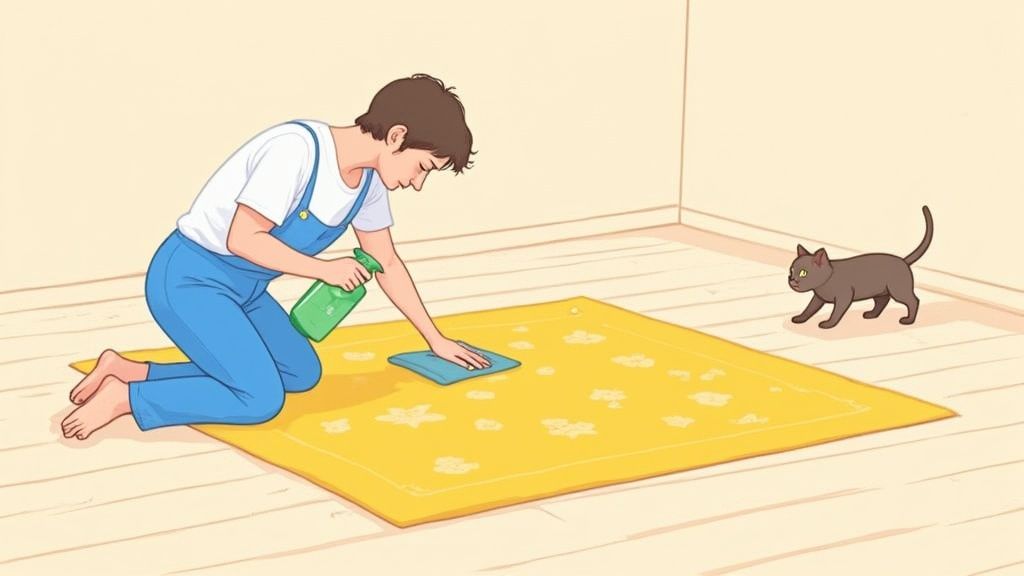
If you've ever discovered a damp, smelly patch on your favourite rug, you know the sinking feeling. When it comes to cat urine, the absolute key is to act fast and arm yourself with an enzymatic cleaner. This isn't just any old soap – it's a specialised product designed to break down the uric acid crystals that cause that persistent, unmistakable smell. Traditional cleaners simply can't touch it.
Remember, never scrub the stain! Always blot gently. Scrubbing just pushes the urine deeper into the delicate rug fibres, making your job much harder.
Why Cat Urine Is So Difficult To Remove
So, you've officially joined a club no one wants to be in: the 'my-cat-peed-on-the-rug' club. Before we jump into the solutions, it’s really helpful to understand why this particular stain is so notoriously stubborn. This isn’t just a simple spill; you're dealing with a complex chemical cocktail.
The real villain here is uric acid, a sneaky compound that doesn’t dissolve in water and forms incredibly strong bonds with the fibres of your rug. As the urine starts to break down, it releases that sharp ammonia smell, but the uric acid crystals hang around. They cling to the fibres and are the source of that lingering odour that seems to reappear on humid days. This is exactly why scrubbing with soap and water often makes things worse—it just spreads the problem around without neutralising the source.
The unique chemical makeup of cat urine makes it incredibly tough to fully eliminate, often leaving behind a strong, lingering musty smell. For broader strategies for eliminating old musty-smells around your home, you might find these expert tips useful.
The Science Behind The Smell
When your cat has an accident, the fresh urine contains urea and other waste products. As bacteria get to work, they start breaking it down, producing the ammonia that creates that first sharp, unpleasant smell. But the real challenge comes later.
What’s left behind are those uric acid crystals. They are completely insoluble in water, which makes them the root of the persistent problem. To win this battle, you need a cleaner that does more than just cover up the scent. Understanding the science helps you pick the right tool for the job.
Failing to get rid of the odour completely can also create a frustrating cycle. Your cat’s sensitive nose will draw them back to the same spot to mark their territory again. You can learn more about how to completely get rid of the cat pee smell in our dedicated guide.
In the UK, acting within the first 24-48 hours boosts your chances of complete stain and odour removal by over 70%. On the other hand, leaving a stain untreated means the failure rate for getting rid of the smell can approach a whopping 60%. This really highlights why moving quickly and using the right method is so important.
Your Essential Toolkit for Cat Urine Removal
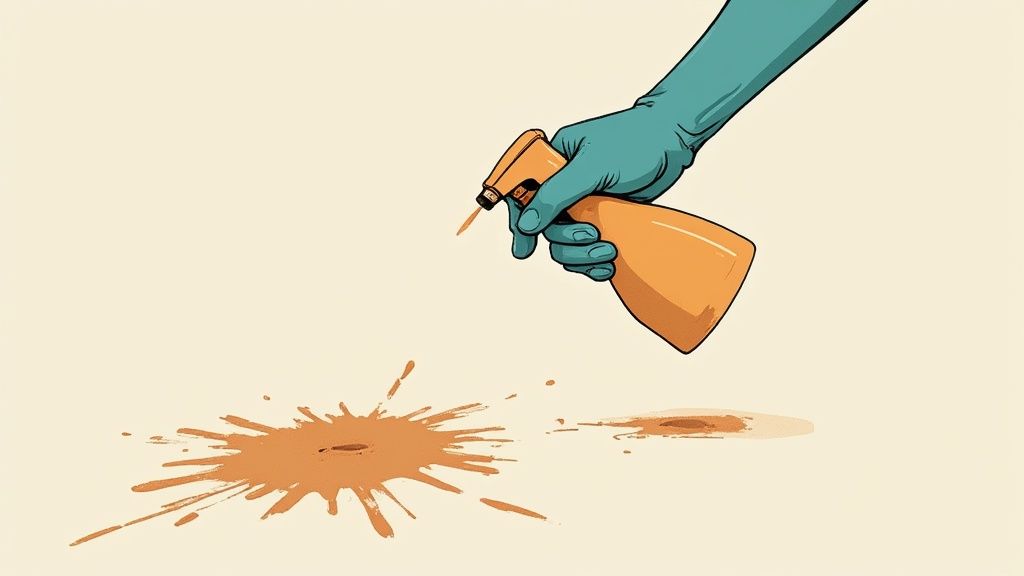
If you're trying to figure out how to get cat urine out of your rugs for good, it's about having the right tools on hand. Acting fast is everything when an accident happens, and being prepared dramatically improves your chances of success. This isn't just a shopping list; think of it as your strategic arsenal for protecting your rugs.
The single most critical item in your kit is a high-quality enzymatic cleaner. These aren't just fancy sprays; they contain active enzymes and beneficial bacteria that literally break down and digest the uric acid crystals in cat pee. It's the only way to truly destroy the odour at its source, rather than just covering it up.
Safety First: Never mix cleaning products. The most dangerous combination is ammonia and bleach, which creates toxic chloramine gas. It’s incredibly harmful to inhale for both you and your pets, so always stick to one product at a time.
Core Cleaning Supplies
Aside from the non-negotiable enzyme cleaner, a few other items will make the entire process much smoother and more effective.
- Paper Towels or Absorbent Cloths: Your immediate reaction should always be to blot, never to rub. A thick stack of paper towels is perfect for soaking up as much fresh urine as you can before you even think about applying a cleaning solution.
- White Microfibre Cloths: Always use clean, white cloths when you're applying and blotting cleaners. This is a small but crucial detail that prevents any dye from the cloth transferring onto your rug, which would just give you another stain to deal with.
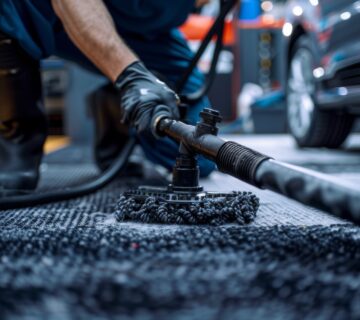
- A Wet Vacuum (Optional but Highly Recommended): While you can manage without one, a small wet-dry vac is an absolute game-changer. It lets you powerfully extract the cleaning solution and all the dissolved gunk from deep within the rug fibres. This not only gives you a better clean but also drastically cuts down the drying time.
DIY Ingredients and Inspection Tools
Even if you prefer a professional-grade product, having a couple of household staples ready can be a massive help. For a more detailed look into how the pros handle it, check out our guide on specialist pet urine carpet cleaning.
A simple 50/50 mix of white vinegar and water is great for an initial spray-down to help neutralise that pungent ammonia smell before you get to the main treatment. Bicarbonate of soda is also a fantastic follow-up; once the area is almost dry, sprinkle it over the spot to absorb any final, lingering smells before vacuuming it up.
Finally, one of the best investments you can make is a small UV torch. Once dry, old cat urine stains are often completely invisible to the naked eye, but they glow brightly under ultraviolet light. A UV torch is your secret weapon for finding every single hidden spot that could be causing that persistent odour in the room.
Right, let's get down to the business of tackling those stains. This is where an enzymatic cleaner becomes your best mate in the fight against cat wee.
When you're figuring out how to get rid of cat urine on rugs for good, these cleaners are the real deal. They aren't just glorified air fresheners; they're clever biological formulas packed with specific enzymes. Their sole job is to find the uric acid crystals in the urine and completely break them down. This isn't about masking the smell—it's about destroying it at the source.
First things first, especially with older, dried-in stains, you have to find every single spot. Remember that UV torch we talked about? Now's its moment. Flick off the lights, give your rug a scan, and you might be horrified to see old, invisible patches glowing back at you. I always recommend lightly circling these with a bit of chalk so you know exactly where to target when the lights come back on. You can't clean what you can't find.
Once you’ve mapped out the problem areas, the golden rule is to blot, never scrub. If the stain is still damp, grab a thick wad of paper towels and press down hard. You want to wick as much moisture as you can out of the rug fibres and, crucially, from the padding beneath. If the stain is old and dry, you can jump straight to the cleaning solution.
Saturation and Patience Are Key
Here’s where many people go wrong: they just give the stain a quick, light spray. That’s not going to cut it. Cat urine soaks deep down into the rug, often spreading out in the underlay into a much bigger patch than what you see on top. For the enzymatic cleaner to work, it has to follow that exact same path.
So, don't be shy with the solution. You need to completely saturate the stained area. Make sure the cleaner soaks all the way through the rug pile and deep into the padding. As a rule of thumb, I always treat an area at least 50% larger than the stain you can see on the surface. This ensures you're tackling the whole problem, not just the tip of the iceberg.
Pro Tip: After you've applied the cleaner, cover the damp spot with a bit of plastic sheeting or even an upside-down laundry basket. This little trick stops the solution from evaporating too quickly. It keeps the area damp, giving those hard-working enzymes the maximum time to do their job and break down every last bit of uric acid.
Patience is absolutely essential here. The enzymes need time to work their magic, which can be anything from a few hours to a full day, depending on the product and how bad the stain is. Always read the instructions on the bottle, but don't be tempted to rush the process.
The Final Rinse and Dry
After the cleaner has had plenty of time to dwell, you need to rinse the area. Get a clean, white cloth, dampen it with cool water, and just blot the spot over and over. This helps to lift out the broken-down urine particles and any leftover cleaning solution from the fibres.
This quick visual shows the basic steps for a fresh stain.
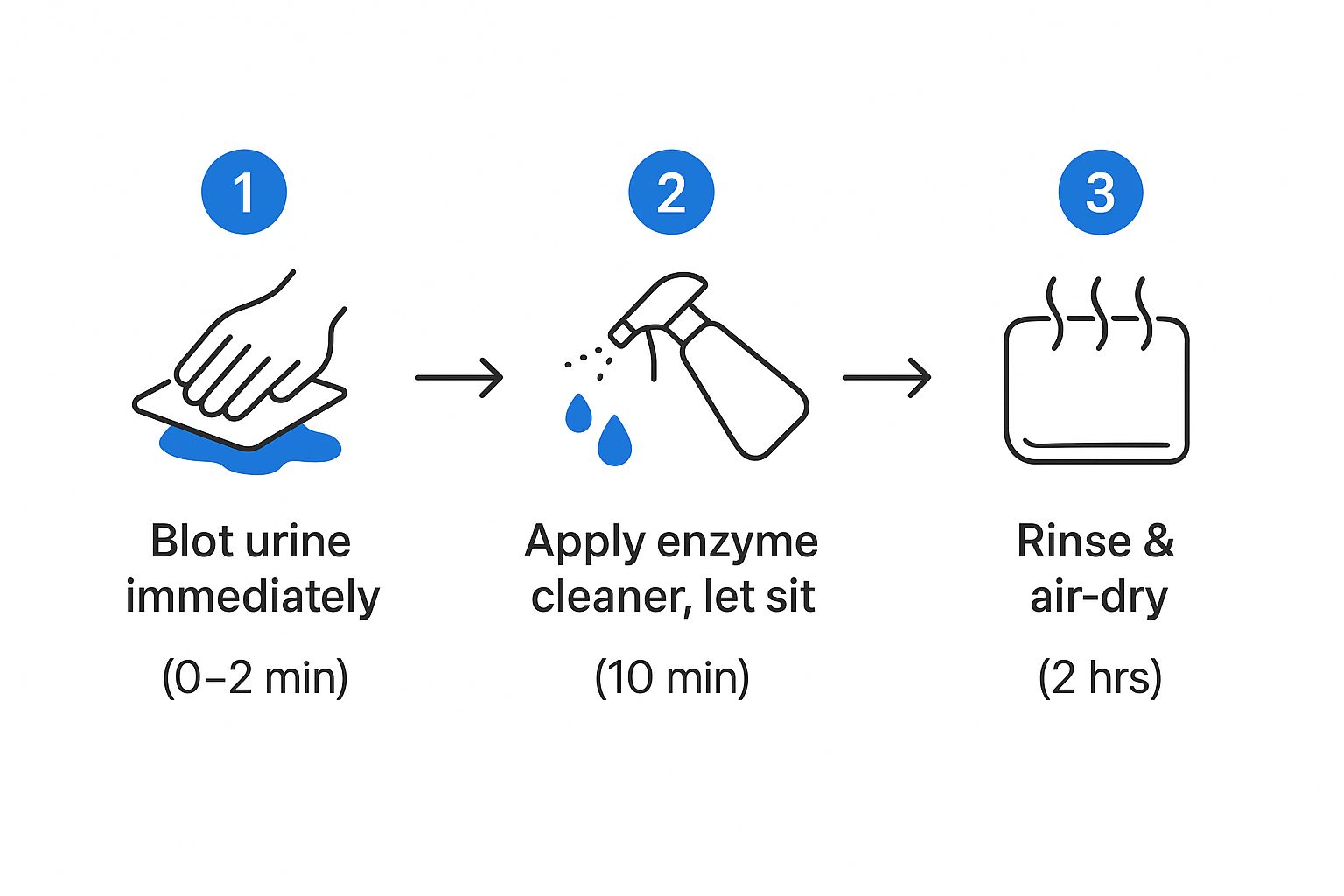
As you can see, the initial work of blotting and applying the cleaner is fast, but the drying phase is where you need the most patience.
Finally, blot the spot with dry towels until you can't get any more moisture out. Then, you just have to let the rug air-dry completely, which could take a day or two. If you're curious about how we handle these situations with our professional gear, you can check out our detailed guide on carpet cleaning for pet urine. Once it’s bone dry, a good hoover over the area will help fluff the fibres back up and restore the texture.
Effective DIY Solutions for Fresh Stains
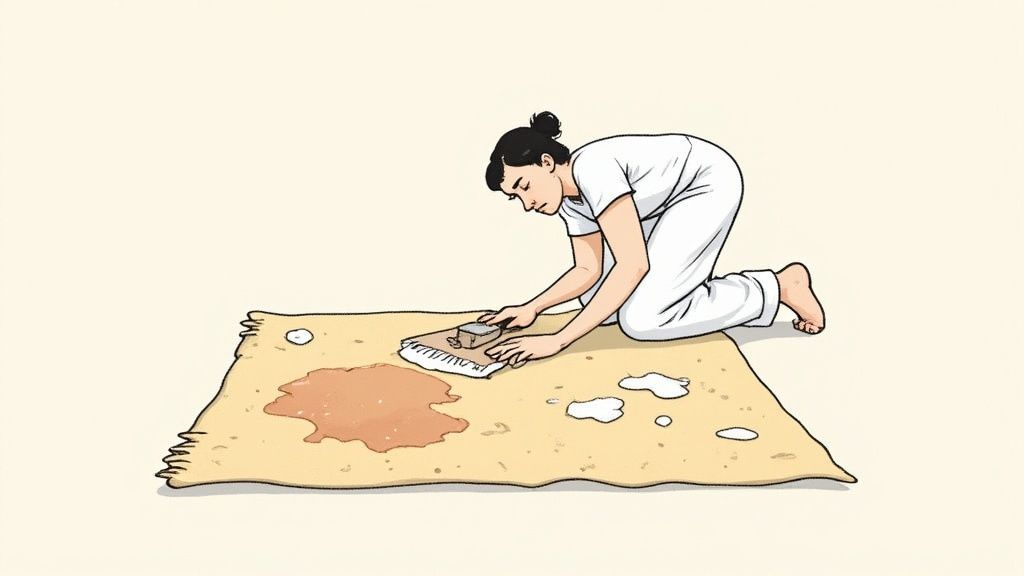
It’s a familiar story: you've just spotted a fresh puddle on your favourite rug late at night, and you're all out of your go-to enzymatic cleaner. Don't panic. When you need to act fast, a few simple household items can be your first line of defence.
A homemade mix of white vinegar and bicarbonate of soda can be surprisingly effective, especially on fresh stains. This DIY method works best before the urine has had a chance to dry and let its uric acid crystals settle deep into the rug fibres. For a new accident, it's a great way to tackle that sharp ammonia smell and start lifting the stain right away.
With over a quarter of UK homes having a feline friend, knowing how to remove cat urine from rugs is a common problem. The UK cat population has now swelled to around 12 million, a number that shot up during the pandemic. Since almost 40% of these homes have more than one cat, accidents are bound to happen, making reliable cleaning know-how absolutely essential. You can learn more about the UK's growing cat population over at Catster.com.
A Simple DIY Recipe and Method
You can create a powerful yet safe homemade cleaner that tackles both the stain and the immediate odour with ingredients you likely already have. While it's gentle on most rug types, it's always a good idea to test it on a small, hidden spot first.
Here's what you'll need:
- White Vinegar: Its acidity is perfect for neutralising the alkaline ammonia in fresh urine.
- Warm Water: This helps dilute the vinegar and dissolve the urine salts, making them easier to lift.
- Bicarbonate of Soda: A brilliant natural deodoriser that mops up any lingering smells.
The first step is always to blot the fresh stain thoroughly with paper towels. You want to absorb as much liquid as you possibly can. Next, mix equal parts white vinegar and warm water in a spray bottle. Give the affected area a light spray, being careful not to completely soak the rug.
Common Hacks to Avoid
The internet is full of cleaning "hacks," but a lot of them aren't suitable for delicate rugs. You should definitely steer clear of any advice that suggests using hydrogen peroxide on coloured rugs. Its bleaching effect can easily cause irreversible colour loss, leaving you with a much bigger problem than the original stain.
Crucial Limitation: It's important to realise that while this DIY method is great for a fresh accident, it has its limits. It can't break down the uric acid in the urine. This means it might not completely get rid of the odour that encourages cats to return to the same spot. For a permanent solution, an enzymatic cleaner is always the best long-term choice.
When to Call a Professional Rug Cleaner
There are times when, despite your best efforts with home remedies, you have to admit defeat. Waving the white flag and calling in a professional isn't a failure; it’s actually a very smart move to protect your rug, your time, and frankly, your sanity.
Deciding to bring in the experts usually comes down to a few key factors. If you’ve used enzymatic cleaners several times but that stubborn smell just keeps coming back, it’s a clear sign the urine has soaked far deeper than any DIY solution can ever hope to reach. This is especially common with older stains or when a cat has repeatedly used the same spot.
Signs You Need Professional Help
Certain situations just aren't suited for a DIY approach and almost always demand professional intervention. Trying to tackle these yourself can easily lead to permanent damage, which only makes a professional restoration job more difficult and expensive down the line.
You should seriously consider calling for backup if you're dealing with:
- Delicate or Antique Rugs: Materials like silk, wool, or those with hand-dyed natural fibres are incredibly sensitive. Using a DIY solution with the wrong pH balance or even just a bit too much water can cause colours to bleed or the fibres themselves to shrink and warp.
- Complete Saturation: Has the urine soaked right through the rug and into the underlay or even the subfloor below? If so, surface cleaning is pretty much pointless. Professionals have the specialised equipment needed to treat these much deeper layers effectively.
- Persistent Odour: A smell that vanishes only to return on a humid day is a tell-tale sign that the uric acid crystals haven't been completely neutralised.
The decision to hire a professional is also an economic one. UK pet owners spend a significant amount on cleaning supplies annually. Professional services are an investment in protecting your valuable rugs and ensuring a healthy home environment.
What to Expect from a Professional Service
When you hire a professional, you’re not just getting a more powerful machine. You're paying for their specialised knowledge and industrial-grade equipment that's impossible to replicate at home. For those really deep-set stains, some cases might require professional carpet shampooing services to lift contaminants from the very base of the fibres.
They often begin with a UV light inspection to map out every single stain with pinpoint accuracy. For the most severe contamination, their best weapon is a full submersion cleaning. This is a careful process where the entire rug is bathed in a special cleansing solution, flushing every fibre clean, before it's moved to a controlled drying environment. This is truly the gold standard for how to remove cat urine on rugs when the problem is serious. For a closer look at what this involves, you might find our guide on professional carpet cleaning for pet urine helpful.
The market for these services is huge. Here in the UK, professional cleaners report that between 30-40% of their household rug cleaning jobs are for pet-related issues, with cat urine being one of the biggest culprits. This high demand just shows how common the problem is and how much homeowners value expert help. You can explore more data on UK pet trends and their impact on households by visiting the Pet Food Manufacturers' Association.
Right, so you’ve managed to tackle the cat urine stain on your rug. That’s a massive win, but as any seasoned pet owner knows, cleaning up the mess is only half the story. The real goal is to stop it from ever happening again. Preventing future accidents involves getting to the bottom of why it happened, which usually means putting on your detective hat and figuring out your cat's behaviour and environment.
A sudden change in toilet habits is almost always a sign that something’s up. Before you jump to conclusions about bad behaviour, your first and most important port of call should be your vet to rule out any underlying health problems.
Things like urinary tract infections (UTIs), kidney stones, or even arthritis can make using the litter tray a painful or difficult experience. A quick check-up with the vet can confirm whether your cat is dealing with any discomfort. If they get a clean bill of health, you can start investigating what’s happening at home.
Creating a Cat-Friendly Environment
Once you've ruled out medical causes, it's time to see your home from your cat's perspective. A happy, comfortable cat is much less likely to toilet in the wrong place. More often than not, the issue is with the litter tray setup – something many of us overlook.
Cats can be incredibly fussy about their bathroom arrangements. To make their litter tray more appealing than your favourite rug, you need to get a few things right.
- Cleanliness is Crucial: Nobody likes a dirty toilet, and cats are no exception. A filthy litter box is a top reason for them to find an alternative. Scoop it at least once a day and give it a full clean with soap and water weekly.
- Location, Location, Location: The tray should be in a quiet, low-traffic spot where your cat feels safe and won’t be startled. Keep it well away from their food and water bowls.
- The Right Number: For homes with more than one cat, the golden rule is one litter tray per cat, plus one extra. This stops any competition and makes sure there’s always a clean option ready to go.
It’s worth remembering that even after a deep clean, a cat's powerful sense of smell can pick up on old odours that we can't. This can draw them back to the same spot. An enzymatic cleaner is essential, as it's the only thing that will truly break down the uric acid crystals and eliminate that scent signal for good.
Addressing Stress and Anxiety
Cats are sensitive souls, and stress is a huge trigger for urinating outside the litter box. A change in routine, a new baby or pet, or even just rearranging the furniture can throw them off balance. If you think stress might be the problem, focus on making their world feel calm and predictable.
You could try a calming pheromone diffuser, such as Feliway, which copies the natural scent cats use to mark an area as safe and secure. Making sure they have plenty of high-up spaces, like cat trees or shelves, also gives them a safe spot to retreat to and watch over their territory.
For more general advice on keeping your home looking its best, feel free to check out our expert carpet cleaning tips to maintain all your flooring.
Frequently Asked Questions About Cat Urine Removal
Even with the best guide in hand, you'll always run into specific questions when you're on your hands and knees tackling a stubborn stain. Figuring out how to remove cat urine from rugs often means dealing with a few unique challenges. Here are the answers to some of the most common queries we get from pet owners.
Why Does the Urine Smell Return on Humid Days?
You’ve scrubbed the spot clean, and for weeks, everything seemed fine. Then, a damp, rainy day rolls in, and suddenly that faint, unmistakable smell is back. It's frustrating, but there's a scientific reason this happens: those pesky uric acid crystals we’ve mentioned.
If your first clean-up didn't completely neutralise and remove every last crystal, they're just lying dormant deep in the rug fibres. Uric acid isn't water-soluble on its own, but it loves to bond with moisture. When the humidity rises, the crystals absorb water from the air, which essentially "re-activates" them and releases that foul odour all over again.
This reappearing smell is the number one sign that your standard household cleaner or a simple DIY mix just didn't cut it. It's a clear signal you need to retreat the area with a proper enzymatic cleaner to finish the job for good.
Can I Use a Steam Cleaner on Cat Urine?
This is a question we hear all the time, and the answer is a definite no. It might seem like a good idea to blast the area with steam to sanitise it, but it’s actually one of the worst things you can do for a urine stain.
The intense heat from a steam cleaner will essentially "cook" the proteins in the urine, permanently setting them into your rug’s fibres. This can make both the stain and the smell virtually impossible to remove later on. You should always stick to cool or lukewarm water and an enzyme-based cleaning formula.
Is It True I Should Avoid Ammonia-Based Cleaners?
Yes, this is absolutely true and a critically important tip. Using any cleaning product that contains ammonia is a huge mistake, and here’s why:
- It Mimics Urine: Cat urine naturally contains ammonia. When you clean with an ammonia-based product, you can inadvertently signal to your cat that the area is a toilet, encouraging them to mark the exact same spot again.
- It Doesn't Solve the Problem: Ammonia cleaners do nothing to break down the uric acid that causes the lingering smell. They might mask the odour temporarily, but the core problem remains.
For these reasons, always check the label of any cleaning product you intend to use and steer well clear of anything containing ammonia.
How Can I Tell If the Urine Has Soaked into the Underlay?
Knowing whether the problem goes deeper than the rug pile is crucial. If urine has seeped into the underlay or even the subfloor, no amount of surface cleaning will ever fully get rid of the smell.
There are a few tell-tale signs to look for:
- A Very Strong, Lingering Odour: If the smell is overwhelming and comes back very quickly after cleaning, it's likely coming from a deeper source.
- A Large or Repeated Stain: The bigger the puddle or the more times a cat has used the same spot, the greater the chance it has soaked right through.
- The "Squish" Test: After cleaning and drying the spot, press down on it firmly with a clean cloth. If you feel any dampness or hear a slight squishing sound, the underlay is almost certainly still holding moisture.
If you suspect the urine has reached the underlay, this is usually the point where calling in a professional is your best bet. They have the specialised extraction equipment needed to pull moisture and soiling from these deeper layers effectively.
Dealing with deep-seated odours and persistent stains requires professional expertise. If you're struggling to completely remove cat urine from your rugs, the team at AG Carpet Specialists is here to help. Our technicians use advanced, non-toxic enzymatic treatments and powerful extraction equipment to eradicate odours at their source. Get in touch with us today.