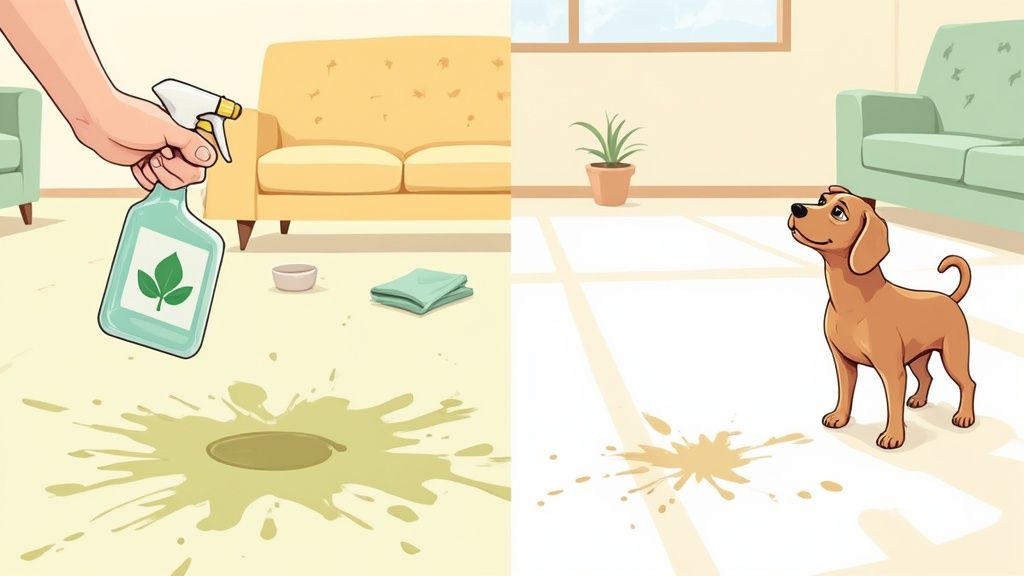
To properly get rid of pet odours, you need to do more than just a surface clean. The secret lies in using a specialised enzymatic cleaner which is designed to break down the uric acid crystals that urine leaves behind. This method gets to the source of the smell, neutralising it and stopping it from coming back when the weather gets humid. For the best results, blot any fresh accidents straight away, treat the area properly, and let it air dry completely.
Why Pet Smells Seem Impossible to Remove
Have you ever cleaned up after a pet accident, thinking you've sorted it, only for that nasty smell to creep back a few days or weeks later? It’s a frustratingly common experience, and it's not just in your head. The problem is a chemical one, rooted in what pet urine is made of and how it soaks into your carpet.
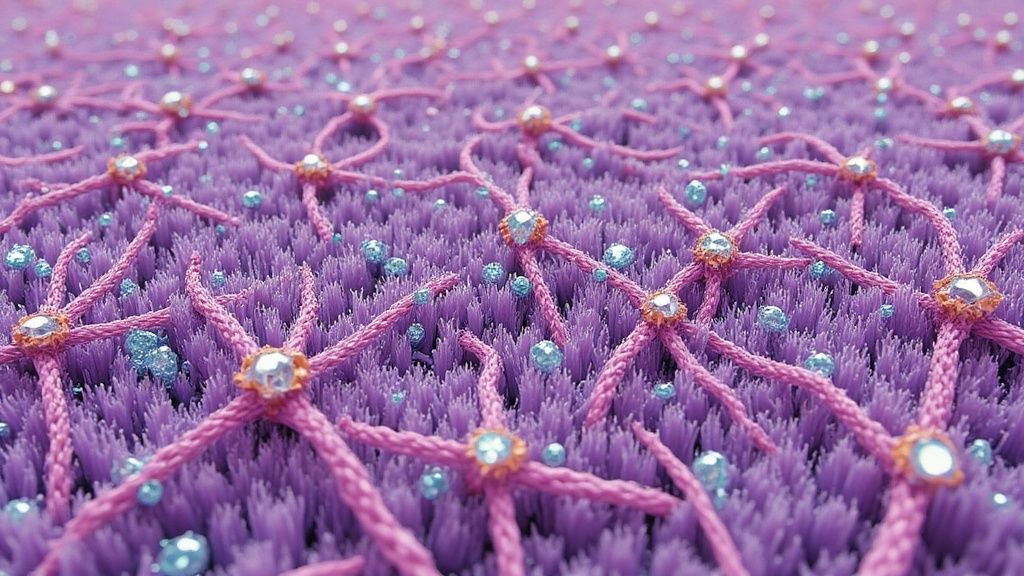
The main offender here is uric acid. This is a tricky compound because it doesn't dissolve in water or your usual cleaning soaps. When the urine dries, it forms tiny, sharp crystals that don't have a smell at first. These crystals get lodged deep in the carpet fibres and, even worse, into the absorbent underlay.
These dormant crystals are why the smell makes a comeback. They can sit there for months, even years, but as soon as they get damp again – from a humid day, a spilt drink, or even steam from a standard carpet cleaner – they reactivate. This releases a powerful wave of ammonia gas. It’s why just shampooing the carpet often seems to make the smell more potent; the moisture wakes up the smell without actually getting rid of the source.
How Carpet Materials Make a Difference
The type of carpet you have also plays a big part in how stubbornly these smells hang around. Different materials handle moisture and odours in their own ways:
- Natural Fibres: Wool carpets, which are very popular in UK homes, are incredibly absorbent. Their porous nature can trap urine deep inside the yarn, making it a real challenge to flush out.
- Synthetic Fibres: Materials like polyester or nylon might be less absorbent than wool, but their dense weave is still a perfect hiding spot for those uric acid crystals to linger.
This is a widespread issue for pet owners. In the UK, where around 60% of households own pets, tackling carpet odours is a constant battle. Scientific studies have shown that enzymatic cleaners are so effective because they are specifically formulated to break down the proteins and uric acid causing these persistent smells—something your typical off-the-shelf cleaner just can't do. When used correctly, a good DIY enzymatic clean can reduce pet odour complaints by up to 75%.
The key takeaway is that you're not just fighting a stain; you're fighting a chemical reaction. To truly remove pet odours from carpet, you must break down and destroy the uric acid crystals.
Understanding the science behind the smell is the first step to winning the war against it. For a more detailed look at getting to the root of the problem, take a look at our guide on carpet cleaning for pet urine.
Your Immediate Response to a Fresh Pet Accident
The moment you spot a fresh pet accident, the clock starts ticking. What you do in the next few minutes is absolutely critical and can be the difference between a simple clean-up and a persistent odour that haunts your home for months.
Most people's first instinct is to grab a cloth and start scrubbing furiously, but this is probably the worst thing you could do.
Scrubbing forces the liquid downwards, pushing the urine past the carpet fibres and deep into the absorbent underlay. Once it reaches the underlay and subfloor, that smell becomes a nightmare to remove. Your primary goal here is to lift, not push.
The Blotting Technique
Your first and most important action is to blot the area immediately. Get a thick stack of plain white paper towels or an old, clean towel and press down firmly on the wet spot. Let the towel soak up as much of the liquid as it possibly can.
Once the towels are saturated, replace them with fresh ones and repeat the process. Don't be afraid to put your weight into it – you can even stand on the stack of towels to apply more pressure. Keep going until the paper towels come away almost dry. You'll be genuinely surprised at how much liquid you can pull out of the carpet this way.
This infographic shows just how massive the difference is between blotting and scrubbing.
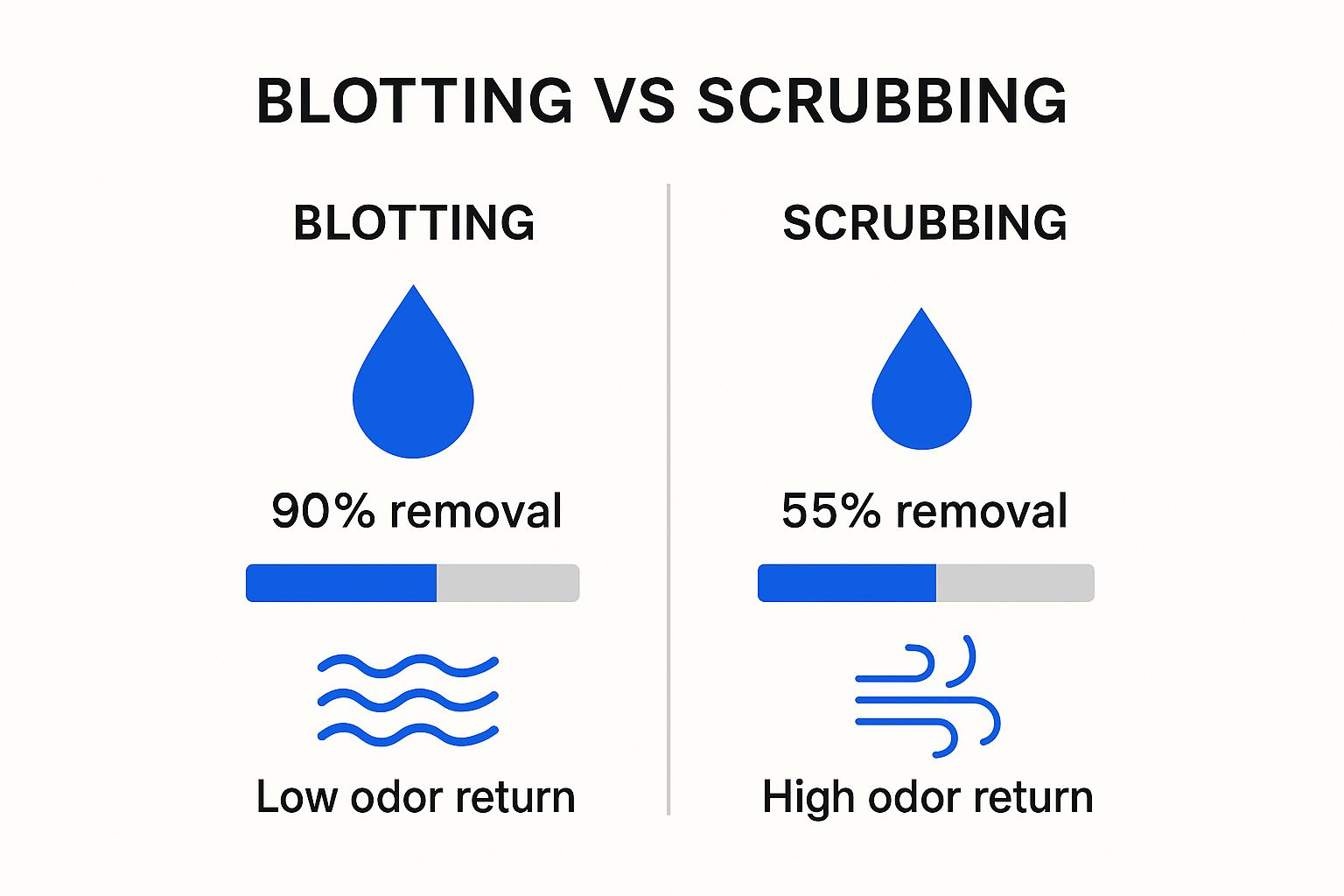
As you can see, proper blotting can remove up to 90% of the urine before it has a chance to soak in. This dramatically reduces the risk of a lingering smell taking hold.
What to Use and What to Avoid
After you've blotted the area as dry as possible, you can apply a simple cleaning solution. A mixture of equal parts white vinegar and cool water in a spray bottle works well to start neutralising the ammonia. Lightly mist the area—don't saturate it—and then blot it again with fresh paper towels to lift the solution out.
A critical piece of advice: never use ammonia-based cleaners on pet urine stains. Urine already contains ammonia, so using a cleaner with the same chemical can actually encourage your pet to mark that same spot again.
Similarly, avoid using a steam cleaner or any form of heat on a fresh urine stain. The heat can permanently set the stain and bond the uric acid proteins to the carpet fibres, making the odour nearly impossible to remove later.
For more detailed steps, you can explore our guide on cleaning pet urine in carpet. By acting quickly and correctly, you set the stage for successful odour elimination.
Powerful DIY Remedies That Actually Work
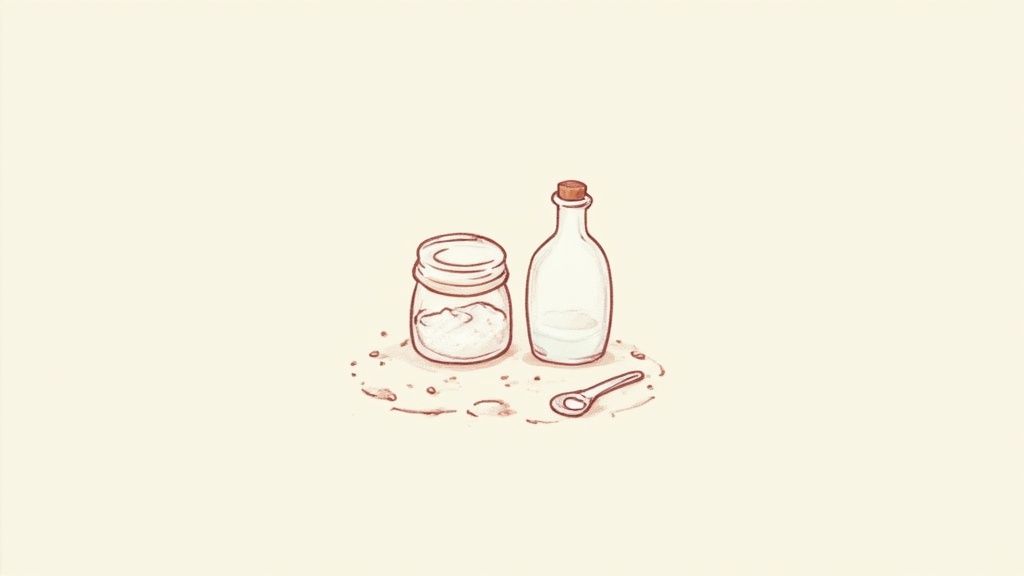
Before you spend a fortune on commercial cleaners, have a quick look in your kitchen cupboards. You might be surprised to find that some of the most effective solutions for pet odours are simple, everyday ingredients you already own. These aren't just old wives' tales; they rely on basic chemistry to get the job done.
It's a common problem. A recent survey of UK pet owners found that while 48% buy specialised pet odour products, a significant 30% still can't shake persistent smells. This usually happens when urine penetrates deep into the carpet padding, which is why you need methods that tackle the issue right at the source.
The two champions of DIY odour removal are, without a doubt, bicarbonate of soda and white vinegar. They are so effective because they work on different components of pet urine, creating a powerful one-two punch against those lingering smells.
The Bicarbonate of Soda Method for Dry Odours
Bicarbonate of soda (or bicarb) is a natural wonder when it comes to absorbing odours. It works by neutralising acids, including the uric acid left behind in old pet accidents. This method is your best bet for older, dry stains where the smell is the primary issue.
- Make sure the area is dry: For this to work, the carpet needs to be completely dry so the bicarb can effectively draw out and absorb the odours.
- Be generous: Don't be shy with it! Sprinkle a really thick layer of bicarbonate of soda over the entire smelly patch.
- Let it sit: Give the powder plenty of time to work its magic. A few hours will help, but leaving it overnight will give you the best results.
- Hoover it up: The next day, get your vacuum out and hoover up all the powder. You should notice a significant improvement in the smell.
Using White Vinegar for Fresh Accidents
White vinegar is an acid, making it brilliant for breaking down the alkaline ammonia found in fresh pet urine. It acts as a natural disinfectant and neutraliser, stopping odours from setting in in the first place.
Simply mix equal parts white vinegar and cool water in a spray bottle. After you've blotted the fresh accident as much as possible, lightly mist the area with your solution. Let it sit for about 10-15 minutes, then blot it again with a clean, dry cloth.
The vinegar smell will be quite strong at first, but don't worry—it will fade completely as it dries, taking the nasty urine smell with it.
For a powerful combined approach on a stubborn, dry spot: first, lightly spray the area with your vinegar solution and let it dry completely. Once dry, follow up with the bicarbonate of soda method. This tackles both the ammonia and the uric acid.
For those looking to compare different household remedies, this table breaks down the most common options.
DIY Pet Odour Remover Comparison
| Ingredient | How It Works | Best For | Carpet Safety Note |
|---|---|---|---|
| Bicarbonate of Soda | Absorbs and neutralises acidic odours like uric acid. | Old, dry stains where the main issue is a lingering smell. | Generally safe for all carpet types, but always hoover thoroughly. |
| White Vinegar | Acidic properties break down the alkaline ammonia in fresh urine. | Fresh urine stains to prevent odours from setting in. | Safe on most synthetic carpets. Test on a hidden spot for natural fibres. |
| Hydrogen Peroxide (3%) | An oxidising agent that breaks down odour-causing molecules. | Very stubborn, set-in organic stains and odours. | High risk of bleaching! Always patch-test on an unseen area. Avoid on wool or dark-coloured carpets. |
| Washing-up Liquid | A surfactant that helps lift dirt and grease from fibres. | Combining with other ingredients to help penetrate the carpet. | Use a small amount; too much can leave a sticky residue that attracts more dirt. |
Remember, always test any solution on a small, hidden patch of your carpet first to be safe.
When You Need Something Stronger
If you're dealing with a particularly stubborn smell that just won't budge, a solution with hydrogen peroxide might be the answer. You must be extremely careful, however, as it can bleach certain types of carpet.
- Mix 120ml of 3% hydrogen peroxide with one teaspoon of plain washing-up liquid.
- After your vinegar treatment has completely dried, sprinkle bicarb over the stain.
- Carefully pour the hydrogen peroxide mixture over the bicarb. You’ll see it start to fizz.
- Gently work it into the carpet fibres with your fingers (it's best to wear gloves for this).
Let the foaming mixture dry completely—this might take a day or two—and then hoover everything up. Crucially, you must patch-test this solution on a hidden area first, like inside a wardrobe, to make sure it doesn’t discolour your carpet.
For more home-made cleaning ideas, take a look at our guide to making a natural carpet cleaner.
Choosing a Commercial Cleaner That Actually Works
While DIY solutions can be brilliant for fresh accidents or faint odours, some stubborn, set-in smells really do demand a more powerful approach. But walking down the cleaning aisle of any supermarket can be overwhelming, with countless products all promising miraculous results. The secret is knowing what you're actually looking for.
Many standard carpet cleaners are, frankly, little more than perfumed soaps. They might mask the unpleasant smell with a nice floral scent for a day or two, but they do absolutely nothing to tackle the root cause. As soon as the perfume fades, those uric acid crystals reactivate with a bit of humidity, and the smell comes roaring back.
To get rid of pet odours from your carpet for good, you need a product that destroys the source of the smell, not just covers it up. This is exactly where enzymatic cleaners come in.
The Power of Enzymatic Cleaners
Think of an enzymatic cleaner as a tiny, specialised cleaning crew. These clever products contain specific enzymes and beneficial bacteria formulated to target and break down organic matter. When you apply one to a pet stain, these enzymes get to work, essentially "eating" the uric acid crystals and odour-causing proteins until there’s nothing left.
This biological process is what makes them so much more effective than standard shampoos. They don't just hide the problem; they eliminate it at a molecular level.
When you're choosing a commercial product, the most important word to look for on the label is "enzymatic" or "enzyme-based". If a product doesn't state this clearly, it's likely just a deodoriser and won't solve your problem permanently.
How to Read the Label and What to Look For
Beyond just the word "enzymatic," a good label gives you clues about how effective the product will be. A quality cleaner should be designed specifically for pet urine.
Here’s what to check for on the bottle:
- Active Ingredients: Look for a blend of different enzymes like protease (breaks down proteins), lipase (breaks down fats), and amylase (breaks down starches). A multi-enzyme formula is always more effective.
- Instructions: The directions should mention a "dwell time" – the period you need to leave the product on the stain to let the enzymes do their job. This can range from 30 minutes to several hours.
- Safety Information: Make sure the product is safe for your specific carpet type. Wool carpets, for instance, can be sensitive to certain chemicals, so it’s always wise to check.
For homeowners prioritising a healthier living space, there are many effective options available. You can learn more in our guide to eco-friendly carpet cleaners.
The All-Important Patch Test
Before you go spraying a new cleaner all over the middle of your living room, you must do a patch test. This simple step can save you from a disaster like a permanent bleach stain or discolouration.
Find an out-of-the-way spot on your carpet—inside a wardrobe, under the sofa, or on a leftover scrap if you have one. Apply a small amount of the cleaner following the instructions and let it dry completely. Once it's dry, check for any changes in colour or texture. If everything looks normal, you're good to go. This little bit of patience is a vital part of the process.
Knowing When to Call a Professional
While DIY methods are fantastic for tackling fresh accidents and minor smells, there comes a point where you might feel like you're fighting a losing battle. Sometimes, a stubborn pet odour has penetrated so deep into the carpet and underlay that no amount of home remedy or off-the-shelf spray will shift it.
Knowing when you've hit that wall is the key to finally getting your home smelling fresh again.
If you find yourself repeatedly cleaning the same spot only for that familiar smell to return, it's a huge red flag. This usually means the source of the odour, like urine, has soaked right through the carpet backing and settled into the absorbent underlay beneath. At this stage, surface treatments simply aren't reaching the real root of the problem.
Signs You Need Expert Help
You've tried everything in your cleaning arsenal, yet the smell persists. This kind of stubbornness is a clear sign that the issue goes deeper than the surface fibres. It's probably time for professional intervention when you notice a few key things:
- Recurring Odours: The smell seems to vanish for a few days after cleaning but always creeps back, especially when it's humid. This is a classic sign that uric acid crystals are hiding deep in the carpet padding and reactivating with moisture in the air.
- Multiple or Large Soiled Areas: If your pet has had several accidents in different spots or one very large one, the sheer volume can easily overwhelm the carpet. It’s almost guaranteed that the liquid has soaked through to the subfloor.
- Odours Without Visible Stains: You can definitely smell pet urine, but you can't for the life of you find the source. Professionals use specialist tools like UV lights and moisture detectors to pinpoint every single affected spot, ensuring nothing gets missed.
What Professionals Do Differently
When you call in the experts, they arrive with equipment and techniques that are far more powerful than anything you can buy or rent. Their main weapon against deep-set odours is usually hot water extraction. This method injects a high-pressure, hot cleaning solution deep into the carpet and immediately extracts it—along with all the dirt and bacteria—with an industrial-strength vacuum.
This process doesn't just clean the surface; it flushes out the carpet fibres and the underlay in a way that rental machines simply cannot match. It’s the difference between rinsing a stain and deep-cleaning the entire structure of the carpet.
For the most severe cases, a professional might need to perform a sub-surface extraction. This is more intensive and involves carefully pulling back the carpet to directly treat and flush the underlay. They might even need to seal the subfloor if the damage is extensive. It's a serious procedure, but it's an incredibly effective way to completely eliminate pet odours for good.
When you're booking a service, be specific. Make sure you ask if they specialise in pet urine odour removal and what their process involves. A standard clean won't cut it. You need a company that understands the chemistry of pet urine and has the right tools for the job. To see what a proper, thorough clean looks like, you can learn more about a professional carpet cleaning process and see how it differs from a simple surface wash.
Your Top Questions About Pet Odour Removal Answered
Even when you think you've done everything right, some pet odour situations can be incredibly frustrating. Let's tackle some of the most common questions and myths I hear from pet owners, giving you clear advice for those really tricky spots.
Is It Okay to Use a Steam Cleaner on Pet Stains?
This is a big one, and unfortunately, it's one of the worst mistakes you can make. It seems logical, right? Heat cleans things. But with pet urine, a household steam cleaner can be a disaster. The intense heat actually sets the stain and odour by bonding the urine proteins to your carpet fibres. Once that happens, it's practically permanent.
What we professionals use is called hot water extraction, which is a completely different beast. We first saturate the area with a powerful enzymatic cleaner designed to break down the uric acid. Only after that crucial step do we flush the area with hot water and immediately pull it all back out with a high-powered vacuum. The takeaway here is simple: avoid applying any heat unless you're absolutely certain the urine has been fully neutralised by an enzyme cleaner first.
How Can I Find Old, Invisible Urine Stains?
You know that frustrating moment when you can smell it, but you just can't see it? More often than not, the source of a lingering odour isn't a visible stain at all. Your best friend in this situation is a UV blacklight. These little handheld torches are cheap to buy and incredibly good at revealing what your eyes miss.
Here’s how to play detective:
- Wait until it gets dark and kill all the lights in the room. This is essential for the UV light to work effectively.
- Get down low and slowly scan your carpet, holding the torch just a few inches from the surface.
- Urine contains phosphors that will glow a very obvious yellowish-green under the UV light, pinpointing every single problem spot that needs your attention.
This simple trick lets you target your cleaning products precisely where they're needed, instead of guessing and wasting your efforts.
Locating and treating every single source of the odour is fundamental. If even one small spot is missed, the smell will linger. A UV light ensures no hidden problem areas are overlooked.
Will Pet Odours Just Go Away on Their Own?
I wish I could say yes, but this is a complete myth. Unlike a bit of spilt milk, pet urine odour doesn't just fade over time. The real culprit is the uric acid crystals that get left behind long after the liquid part has evaporated. These crystals aren't water-soluble and they don't break down on their own.
They can lie dormant in your carpet and underlay for months, even years, without you noticing. But the moment they get damp again—think high humidity on a rainy day, a spilt drink, or even mopping a nearby floor—they re-activate. That’s when you suddenly get hit with that strong, familiar ammonia smell all over again. The only way to truly solve the problem for good is to use a cleaner that is specifically designed to destroy these crystals.
For many homeowners, achieving an odor-free home is the ultimate goal, and understanding the science behind the smell is the first step.
If you’ve tried everything and that stubborn odour still won’t budge, it might be time to call in the professionals. At AG Carpet Specialists, we use advanced hot water extraction and specialised enzymatic treatments that get deep into the carpet and underlay to eliminate pet odours for good. Contact us today at https://www.agcarpetspecialist.co.uk for a free, no-obligation quote and let us restore that fresh, clean feeling to your home.